
We measure stable isotopes in air and ice to better understand the Earth's climate systems. We excel at measurements of δ13C and δ18O in atmospheric carbon dioxide, δ13C of atmospheric methane and local sources of elevated methane, and δ2H and δ18O in water from ice cores as well as in environmental waters. Read more about our research below!

Bruce Vaughn
Lab manager

Sylvia Michel
Lab manager

Tyler Jones
Faculty fellow

Jianghanyang (Ben) Li
Faculty fellow

Bradley Markle
Faculty fellow

Pieter Tans
Faculty fellow emeritus

Kerstin Braun
Research staff

Reid Clark
Research staff

Valerie Morris
Research staff

John Ortega
Research staff

Brooke Chase
Grad student

Kevin Rozmiarek
Grad student

Taline Leon
Research assistant

Paloma Siegel
Research assistant

Panorama of the INSTAAR Stable Isotope Lab
Contact us
Come visit! We are in the southeast corner of SEEC (Sustainability, Energy, and Environment Complex) at 4001 Discovery Dr.
Or call! 303-492-5495
We provide analytical services to scientists and institutions around the world. Find more info below.
Our team
We're a dedicated crew from different scientific backgrounds and experiences, but with common purpose: to understand the Earth's climate system, the carbon cycle, and global change. We work together in the lab and in the field in our shared mission. We also try to have some fun!

Some current and past SIL team members, from left to right: Bruce Vaughn, Brad Markle, Sylvia Michel, Valerie Morris, Reid Clark, Chloe Brashear, Seth Kurtz, Kevin Rozmiarek
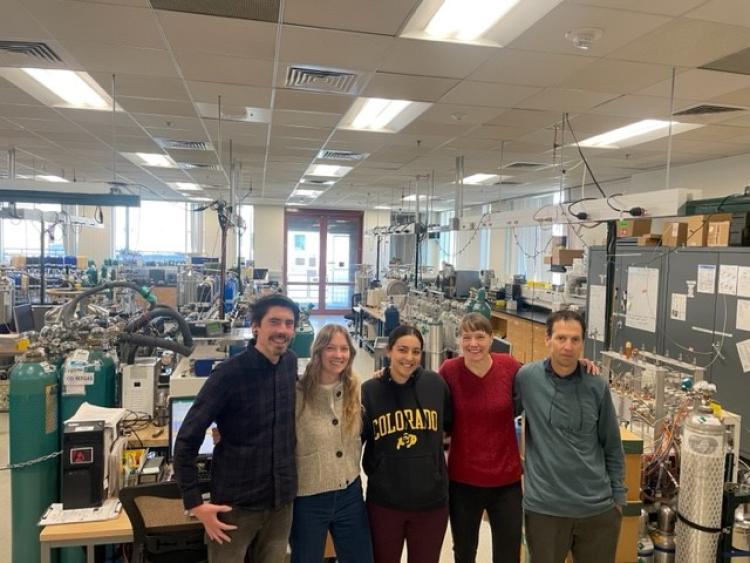
Current and past members of the greenhouse gas team: Reid Clark, Chloe Brashear, Taline Leon, Sylvia Michel, John Ortega

SIL folk take a tour of Niwot Ridge, above INSTAAR's Mountain Research Station.
Blog headlines
- Welcome Kerstin!
- Alaska NNA team update
- A send-off for Chloe!
- An isotope introduction
Are you interested in being a SIL team member?
- Prospective graduate students: please reach out to our principal investigators Tyler Jones, Brad Markle, or Ben Li!
- Prospective undergraduates and Professional Research Assistants: please add your name to this form and email an introduction to Sylvia.
Research
Stable isotopes are a unique tool because they indicate, record, integrate, and trace processes in the global environment. The INSTAAR Stable Isotope Lab partners with researchers from a variety of academic institutions and governmental agencies worldwide in interdisciplinary research into Earth systems.
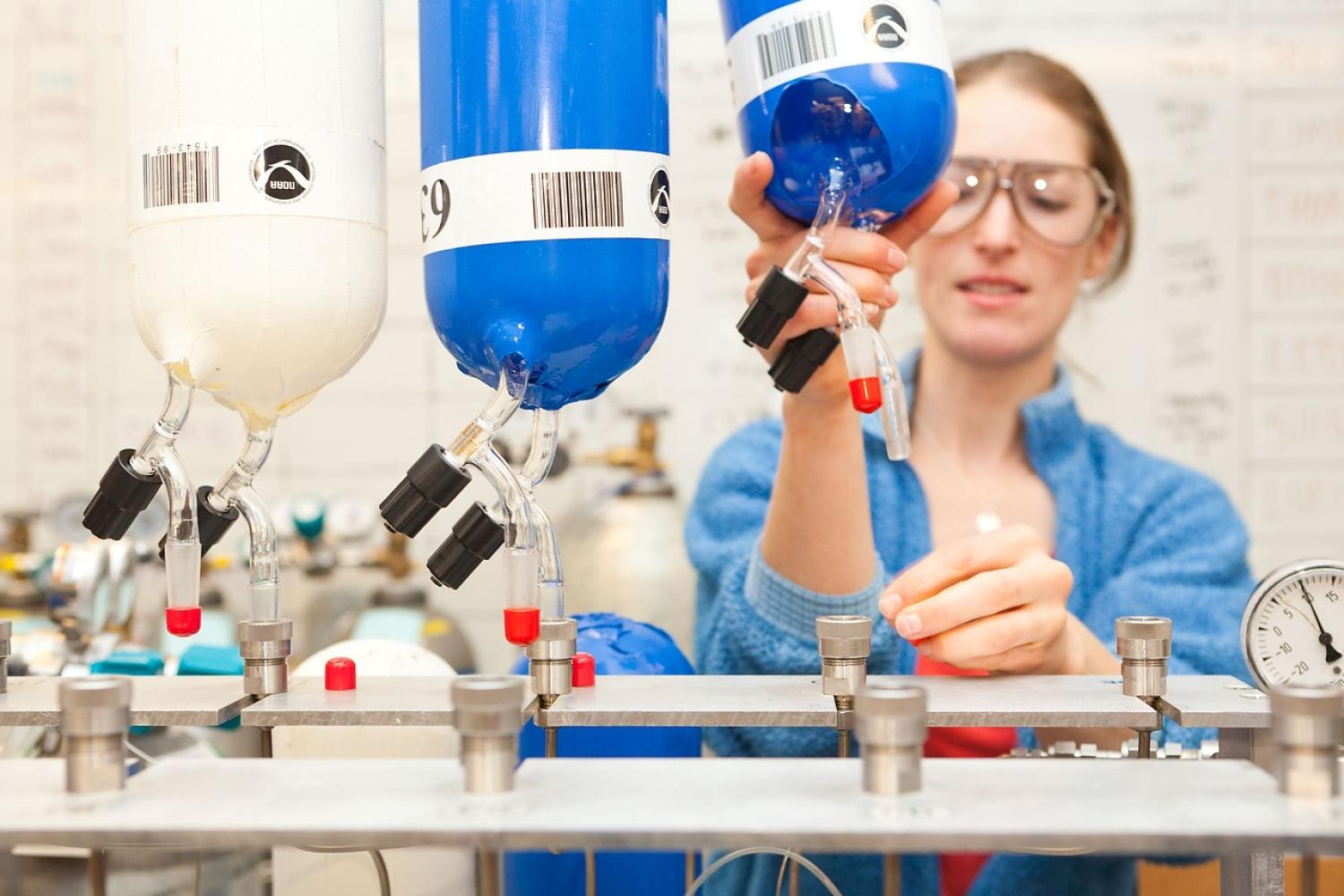
Rachel Edie changes gas flasks out on Spock, a mass spectrometer that measures stable isotopes of carbon and oxygen in atmospheric CO2 from the NOAA Global Monitoring Laboratory's Global Greenhouse Gas Reference Network. Photo by Ethan Welty.
Earth's climate is changing due to the increase in anthropogenic greenhouse gases. The most important of these is carbon dioxide - and yet we don't fully understand fluxes of CO2 between the biosphere, the atmosphere, and the ocean. Stable isotopes are very useful for understanding these exchange processes because of fractionation: different isotopes of CO2 move between these different pools at different rates. For instance, because plants strongly discriminate against the heavy isotope of CO2, we can use δ13C-CO2 (the 'isotope delta' value) to estimate ocean versus land uptake of carbon dioxide.(Learn more about why isotopes are useful for understanding sources and sinks of carbon!)
The INSTAAR Stable Isotope Lab (SIL) has collaborated with the NOAA Global Monitoring Laboratory since 1990. This involves measuring δ13C-CO2 and δ18O-CO2 from flasks and programmable flask packages from the Global Greenhouse Gas Reference Network. We proudly maintain the largest dataset of stable isotopes in the world. You can play around with data here. We will be updating our CO2 isotope data soon! Contact Sylvia Michel for more information.

Methane is also a very important greenhouse gas, and the atmospheric burden of methane is increasing rapidly for reasons we don't fully understand. Because sources of methane have different isotopic signatures, we can use δ13C-CH4 to test hypotheses about where that increase has come from - and studies suggest that the increase is primarily from a biogenic source, like wetlands or agriculture, though fossil fuel sources are a bigger fraction of emissions than we once thought. Modeling CH4 as well as its isotopes helps us understand the methane budget, and this will potentially guide climate-sensitive policy decisions. Read more about the utility of our measurements in this recent publication by our colleague Sourish Basu, or this one by Xin Lan.
In cooperation with NOAA GML, the INSTAAR Stable Isotope Lab (SIL) has been measuring δ13C-CH4 of methane since 1998, and we have the largest collection of data in the world. We work closely with collaborators around the world making similar measurements to improve our data compatability.
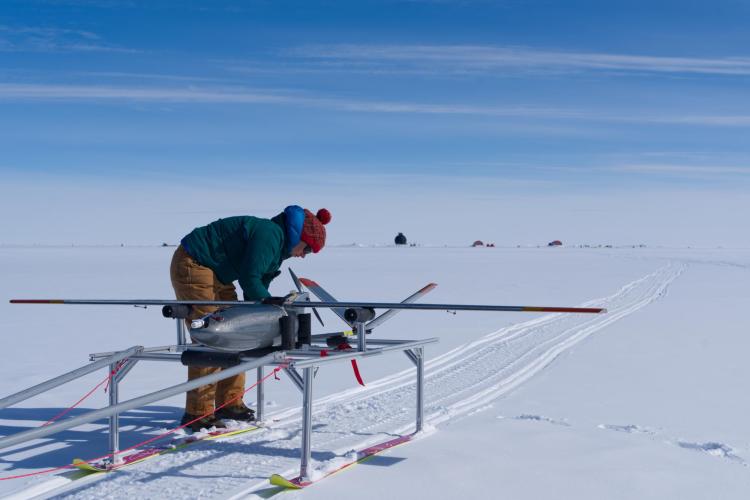
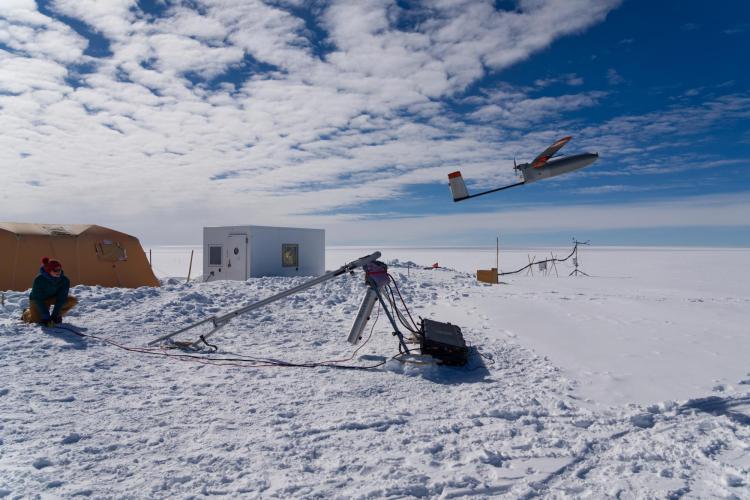
In the world of ice cores, we make the assumption that the isotopic composition of precipitation that falls over Greenland represents the composition of the ice sheet itself. Is that true? What about sublimation? Does sublimated vapor leave the ice sheet system and what does that mean for its mass balance? At SIL, we work to answer these questions by taking a closer look at the water vapor isotopes above the ice sheet. By using a large fixed-wing Uncrewed Aerial System (UAS) or drone, we meet the vapor on its terms. At the East Greenland Ice Project field camp, we profile the atmosphere up to 1500 m above the ice sheet and capture water vapor for isotopic analysis. By looking at that information, we glean insights into the hydrological cycle of Greenland and can challenge assumptions made about its dynamics. For more information, take a look at our most recent publication.
This work involves many hands. Here at SIL, you can find Kevin Rozmiarek, Bruce Vaughn, Valerie Morris, and Tyler Jones working on water vapor. Past SIL team members Chloe Brashear, Hayley Bennett, and Will Skorski spent time in the field flying with us. Our UAS operations are enabled and empowered at CU through Director of Flight Operations Daniel Hesselius. Our work is funded by NSF.


As much as 50% of the world's soil carbon is sequestured in the northern boreal latitudes in perennially frozen ground or permafrost. Current and future carbon emissions from these stocks are unknown, largerly due to the spatial gaps in observations and uncertainties in the mechanics of methane and carbon dioxide production. Here at SIL we are working toward building observation systems using our fixed-wing Uncrewed Aerial System (UAS, or drone) that enable new understanding of the way carbon is introduced into the atmosphere. At our field site in Alaska, close to permafrost emission sources, we use a suite of aerial measurements - in-situ measurement of methane, soil moisture radiometer, multispectral camera, and methane-isotope gas capture - to constrain isotope-enabled biogeochemisty models. These models in turn inform the future of carbon release from permafrost and ultimately, the future of climate.
At SIL you'll find Kevin Rozmiarek, Tyler Jones, Bruce Vaughn, Valerie Morris, Taline Leon, and Paloma Siegel all working on permafrost. Our UAS operations are enabled and empowered at CU through Director of Flight Operations Daniel Hesselius. This work is funded through NSF's Navigating the New Arctic program and with lab partner Sandia National Laboratories.
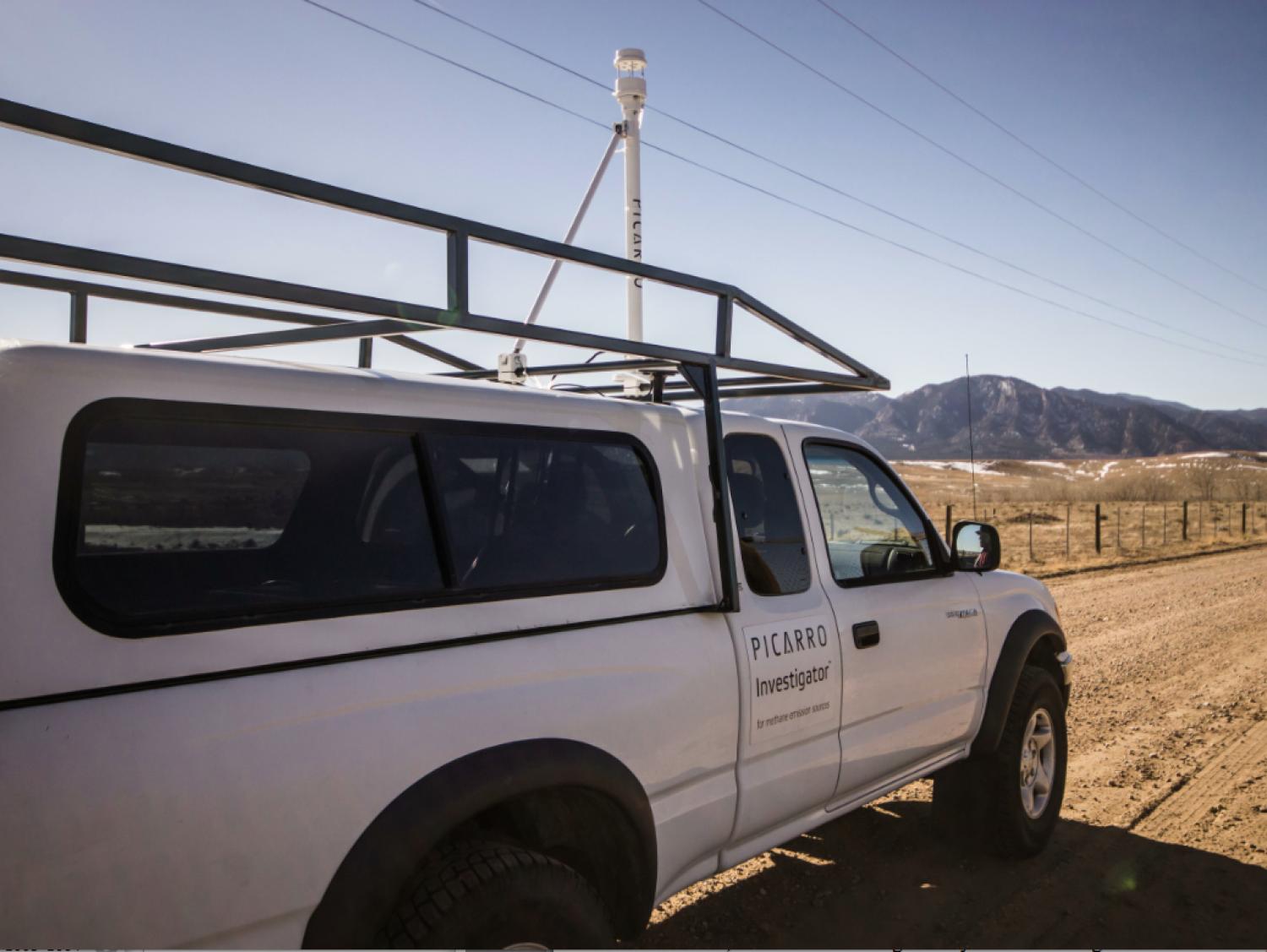
The Mobile Methane Analyzer. Photo by Christi Turner.

Visual display of a mobile methane sampling along roads in Weld County.
SIL participated in the CU-based, NSF funded Sustainability Research Network called the Air Water Gas project which is aimed at studying the oil and gas industry in the Rocky Mountain West. The mission of this project was to provide a logical, science-based framework for evaluating the environmental, economic, and social trade-offs between development of natural gas and protection of water and air resources. The project educated the public and influenced the development of policies and regulations governing natural gas and oil development.
Unlike all of our lab-based measurements, Mobile Methane measurements are recorded on the fly as the vehicle drives. The data are plotted onto an interactive map and Landsat image.
Services
We provide analytical services to scientists and institutions around the world.
| Analysis | Analysis Mode | Sample Volume | Precision (‰) | Cost Per | Analysis Time | Limitations | |
|---|---|---|---|---|---|---|---|
| C & O: atm. carbon dioxide | δ13C δ18O |
dual inlet | 400 cc minimum 1 Liter preferred |
±0.015 ±0.05 |
$60 | 4-6 wks | Near-ambient concentrations of CO2 in air |
| C: atm. methane | δ13C | continuous flow | 40 cc minimum 1 Liter preferred |
±0.1 | $240 | 4-6 wks | Near-ambient concentrations of CH4 in air |
| H & O: liquid water & ice | δD δ18O |
dual inlet | 2ml minimum 15 ml preferred |
±0.5 ±0.07 |
$50 | 4-6 wks | Relatively clean samples, please! |
Stable Isotope Lab by the numbers
7
Full-Time Technicians
+ grad students
30+
Years
of operations
36+
Publications
in Nature or Science
180+
Publications
assoc. with the lab
800
Square Feet
of freezer space
at -20°C/-4°F
3000
Gallons
of liquid nitrogen
on demand
8000+
Square Feet
of lab space
25,000+
Analyses
per year
Instrumentation
Our equipment includes
- Dual-inlet and continuous-flow isotope-ratio mass spectrometers
- Laser-based cavity ring-down spectrometers.
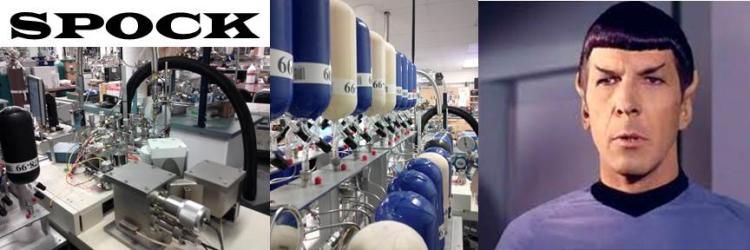
Spock is a Micromass dual inlet mass spectrometer that measures the stable isotopes of carbon and oxygen in atmospheric CO2, primarily from flasks and standard cylinders with the NOAA CMDL Cooperative Air Sampling Network. CO2 is extracted from an air sample by pulling the air through a water trap and into a liquid nitrogen trap. The sample is then heated to expand into the sample bellows of the mass spectrometer. The sample and reference gas are then iteratively allowed into the source where they are ionized, repelled down the flight tube, and separated by isotopic mass. Reliable measurements of CO2 isotopes depends on careful data crunching and quality controls—please contact us if you'd like more information on our procedures.

T'Pol is a GV Isoprime dual inlet mass spectrometer dedicated to running isotopes of CO2 from programmable flask packages. These collect air from aircraft and from tall towers, allowing for sampling along vertical gradients. The sample extraction is almost identical to Spock: CO2 is cryogenically separated from air and expanded into the sample bellows for dual inlet analysis against a CO2 reference gas. Careful monitoring ensures that different instruments measure samples with high accuracy and precision.

Picard is also a GV Isoprime with a similar extraction system as T'Pol and Spock. Although it can measure samples from flasks and programmable flask packages, it is primarily devoted to measuring air from calibration cylinders. Picard has the capacity to measure CO2 extracted from carbonates, as this is the reference material for CO2 isotopes.

Troi measures carbon isotopes of methane. Since there is not enough methane in a network flask to measure using dual inlet techniques, we rely on continuous flow measurements, where the sample moves on a stream of helium gas. Methane and other gases are frozen on a pre-concentrator of hayesep-D, cryo-focused, and separated on a GC column. The CH4 is combusted to CO2, and then the sample is "sniffed" from an open split into the mass spectrometer.

Crusher will soon measure hydrogen isotopes of methane. This measurement is challenging due to the high-temperature pyrolysis furnace which converts CH4 to H2 gas.
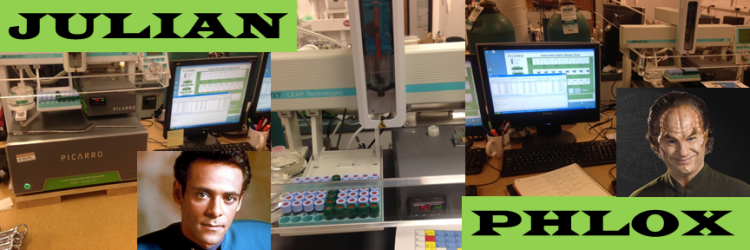
Julian and Phlox are Picarro cavity ring-down mass spectrometers dedicated to measuring hydrogen and oxygen isotopes of water from discreet samples.
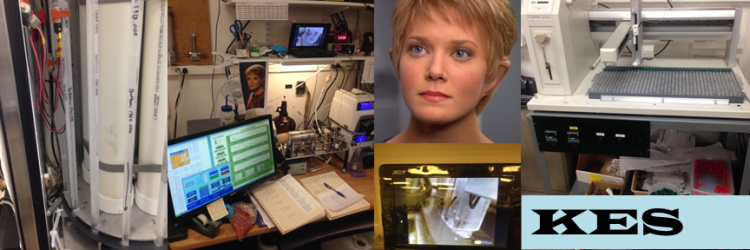
Kes measures water isotopes from ice-cores. Kes represents is a breakthrough in our ability to obtain high resolution records from ice cores. As the ice is melted, peristaltic pumps move the water into a de-bubbler, splitter (where a portion of the sample is archived), a nebulizer, then vaporized and measured by CRMS.
---
Overview video (90 sec)
Watch an 90 second overview of the Stable Isotope Lab. The video will automatically start at the 2:30 mark. This overview is part of a tour of two INSTAAR labs. The first part of the video gives an overview of the Laboratory for AMS Radiocarbon Preparation and Research.
Partners

National Oceanic and Atmospheric Administration (NOAA). We work closely with NOAA’s Global Monitoring Lab, providing critical isotopic constraints on the sources and sinks of major greenhouse gases and related carbon- climate feedback processes—constraints which are not otherwise available from observations of trace gas concentration alone.

National Science Foundation (NSF). Many of our projects have been supported under the leadership of the National Science Foundation.
Collaborators
We also collaborate with colleagues at many universities, government labs, and other science organizations and communities around the world.
News

Sylvia Michel receives INSTAAR’s first Outstanding PRA Award

The Arctic's permafrost-obsessed methane detectives (Wired)
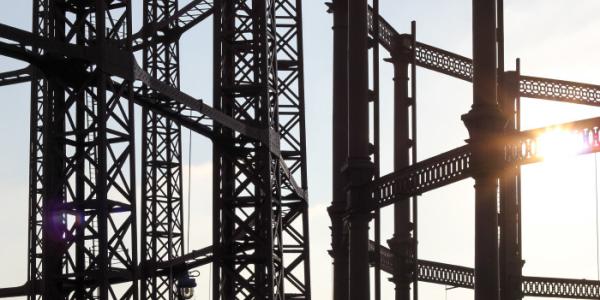
London produces a third more methane than estimates suggest (Imperial College London)
Publications
Publications by people associated with the Stable Isotope Lab.
